A learner is like a box of chocolates...you never know what you're gonna get! I hope you recognize my shameless Forrest Gump plug. Hey, a classic is a classic! And in this case, this analogy couldn't be more perfect for describing learners today. In my previous posts, I've mentioned how the classroom is changing, and fast. I've talked about how gone are the days where students effectively learn by sitting and copying notes in a lecture type setting. Here we are living in a time where knowledge is everywhere, and one of the key skills we need to teach our students is how to access and use that knowledge which is all around us.
So how exactly is a learner like a box of chocolates? Well, based on Connectivism Theory, learning is no longer taking place exclusively within the human mind. The Changing Nature of Knowledge says that The leaners themselves, the connections they form with each other, the connections they form with databases, with other sources of knowledge, is really the primary point of learning. So in essence, the network becomes the learning. So as teachers, or future teachers, it is very important for us to remember that each student we will have in our classroom will be a source of valuable knowledge to us and to their classmates. It is impossible for one of us to know everything, and each student, like a box of chocolate, brings something new to the classroom. This could be a perspective, a learning style, a different culture, a piece of knowledge, a new technology, really, the options are limitless. It could even be a new way to connect and gain access to more knowledge. Each of us is a database with information ready to be shared. It is our responsibility as teachers to foster these connections and let students learn how to make their own connections, share knowledge, and explore for more.
To elaborate on Connectivism, let me begin by saying this theory was new to me. If it's new to you too, the name more or less explains itself. In very simplified terms, it's about how learning in the present age is more connected than it was in the past. It's a theory which describes our current learning situation. In Connectivism: A Learning Theory for the Digital Age, Siemens says that Connectivism presents a model of learning that acknowledges the tectonic shifts in society where learning is no longer an internal, individualistic activity. That's right- learning is now very interconnected. Interconnected via books, via the internet and databases, and via all sorts of technologies which are readily and easily accessible. And this interconnected learning shouldn't be taking place only on a world-wide scale, but also should be happening within the walls of your classroom. Remember, your learners are like a box of chocolate- each with something unique to bring.
My final thought is are our classrooms teaching students to live in a connective age? Not necessarily. Siemens states that The field of education has been slow to recognize both the impact of new learning tools and the environmental changes in what it means to learn. I included the cartoon here because when I started looking up more information on the theory I found some negative feedback. I think connectivism isn't not about teaching our students "how NOT to think," but rather, giving them the skills they need to access limitless information, think critically, and apply it. It's not about teaching mindlessness, but rather mindfulness and the power that lies in having access to mountains of information we never had before, and how to evaluate it properly. If we as teachers embrace connectivism, it will allows us to teach the skills necessary for our students to not only learn the required material, but to succeed in a digital age. With the skills and tools for how to search for answers and acquire new knowledge, our students will be equipped for whichever career path (or paths!) they head down in the future. To start embracing connectivism in your classroom, just remember our wise friend, Forrest. A learner is like a box of chocolates.... You never know what you're gonna get.
This blog follows my journey while abroad in Costa Rica to becoming a Spanish teacher: The Future Señora Danielle. I will be documenting my ideas, notes from my studies, and personal anecdotes that shape my path to becoming a foreign language teacher. ~Pura Vida~
Showing posts with label technology. Show all posts
Tuesday, October 4, 2016
Friday, September 30, 2016
DIIGO and Pinterest: Two Tools for the Tech Savvy (or not) Teacher
This week in grad school I was asked to check out two
websites: DIIGO and Pinterest. Lucky for
me, I am at least tech savvy enough to be pretty familiar with Pinterest (see
last week’s post on being “behind the tree!), so I only had to check out DIIGO.
Well, I am pretty impressed with both sites. So cheers to my first ever tech
review!
My final thoughts: For one, I feel so lucky to be living in
a time where we as teachers have so many resources to help us be innovative in
the classroom. Both Pinterest and DIIGO
are examples of social sharing sites that you can absolutely use as a teacher
(and probably should!). We can connect
with and get ideas from people all over the world. As for me, these tools will
both be in my repertoire for years to come! Unless... even better resources and
websites are developed soon—which wouldn’t surprise me!
Thursday, September 15, 2016
21st Century Teaching...Am I Ready?
Classrooms are evolving what seems to me to be overnight. Long gone are the days of traditional lectures
with students taking notes with pen and paper.
More and more frequently I am hearing talk of technology in the
classroom. But what exactly does that
mean? I’ve been living abroad in Costa
Rica for the last two and a half years and I can’t help but feel a little
behind. From my little school with no computers, no wifi, and no projectors,
the rate at which technology is being incorporated into classrooms back home seems even
faster. The technological wave has hit.
Now it’s not just the one “Smart Classroom” in a school (which is what I remember), but it’s common
for teachers have Smartboards, for students to have iPads, etc. So as I prepare myself
to make the transition back to New York and into a classroom embracing the 21st
century, I have to ask myself… what exactly does this classroom look like, and
am I ready?
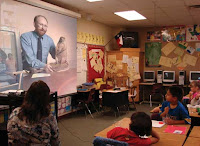
But what does using technology in the classroom actually look like? Like I said, I am coming from two and a half years of teaching in a school that might seem like a time capsule from the past for some of the more tech savvy teachers out there! In Costa Rica there is a phrase "detrás del arbol" (literally translating to "behind the tree") which is used to describe people who are out of the loop. As much as I don't want to admit it, I myself have become victim to being behind the tree, and need to do some exploration to find out what a modern classroom looks like. In A Vision of 21st Century Teachers, teachers share some of their tech methods in the classroom. Some of the many excellent examples were blogging, creating digital music mixes, collaborating to make mixed media presentations, using a camera to capture math in the real world, and creating digital books. My favorite suggestion was using technology to take virtual field trips. Imagine my future classroom, where students come in not only to learn Spanish, but to explore the world and its cultures right there from their seats! Probably the biggest takeaway from this video is the rationale for why teachers use technology in the classroom. It gives students confidence, it prepares them with skills they will need in the future, and it allows the teacher to meet the needs of students with different learning styles.
![]() |
| Virtual Field Trip to Carnegie Museum |
Until next time!
The Future Señora
Pura Vida
Pura Vida
Subscribe to:
Posts (Atom)