Showing posts with label 21st century learning. Show all posts

Tuesday, November 15, 2016

Using Podcasts in the Spanish Classroom

Okay, let's imagine we are back in our high school Spanish classroom.  The teacher pulls out the outdated CD/Cassette player, and we all know it's time for the dreaded task: listening!  But why did we dread this activity so much? For one, we were mostly only accustomed to listening to our one Spanish teacher and their accent.  Two, didn't it always seem like the speakers on the audio spoke so much faster than the "teaching pace" used in the class regularly? And three, there wasn't always some pressure associated with it- like a graded quiz or test?

Listening is a key skill required for foreign language learning, and often students aren't exposed to it (or variations of it) enough. My suggestion today is: Podcasts.  I think they are a great way to UP the level of Spanish being heard by your students and to help take away the "fear" so often associated with these types of listening activities.  Actually, a creative teacher can turn these listening activities with Podcasts into something fun!  WebSpanish at Podomatic.com has a ton of short 2-3 minute audio podcasts from beginner to upper intermediate which you can easily find time for in your classroom.

“¿Qué vas a hacer este fin de semana?”  is a 2 minute Podcast at the "Upper Basic" level for students to hear a quick conversation between two people about their weekend plans.  One fun way to use this specific audio in your classroom would be as an "Exit Slip." Students all listen to the Podcast together in class and need to either answer a question about the weekend plans discussed (like what movie are they going to go see?) or write down their own response about one of the plans mentioned in the audio.    Students could be required to answer in the appropriate verb form (ellos van a ....), and this would allow the teacher to see if the grammar learning objective has been met.  Additionally, this would help students better their interpretive communication as they listen, interpret, and and analyze what is heard.

Other ideas for Podcasts in the language classroom:

  • Use it as part of your "Flipped Classroom" and have students listen to or watch video podcasts for homework introducing new grammar, vocabulary, or cultural concepts
  • Have students make their own podcasts and listen to their classmates 
  • Create learning stations around the classroom with different podcasts to listen to

Wednesday, November 2, 2016

Comic Strips in the Spanish Classroom

I never had the opportunity to make a comic strip when I was in school, but during my time teaching abroad in Costa Rica I had my fourth grade class make a comic book strip about one of the stories we had just read in class.  My school didn't have much technology (no wifi, no computers in the classrooms), so I had printed off copies of comic strips for my kids to use.  They absolutely LOVED it. They got to be creative and artistic, while at the same time improving their writing skills.  This project allowed me to check for reading comprehension, too. Would I do this again? Absolutely.  Imagine the possibilities in a school where you could use technology, too! One of the sites my grad professor pointed us too this week was Strip Generator. It's an easy to use platform where you can pick your comic book layout, and add characters and text/thought bubbles by clicking and dragging.

So how can we use tools like Strip Generator in a foreign language classroom? I think creating comics are a fun and excellent tool for students to use when learning a language. It can be a great tool to practice vocabulary or demonstrate ability with a specific grammar concept. I made an example comic for my students to practice talking about the future by using "Ir (conjugated) + a" and "Ir (conjugated) + a + ir (infinitive) + a" called ¿Que va  a hacer Pilar?


If I had my students create their own comic strips using this same grammatical form, the performance indicators they would demonstrate at the intermediate level are:
  • Communicate using high frequency and personalized vocabulary within familiar themes or topics- Students should be able to use a variety of vocabulary to communicate future plans
  • Comprehend simple stories, routine correspondence, short descriptive texts or other selections within familiar contexts-Students should be able to follow and understand the comic strips, and demonstrate this ability of correspondence by showing conversations between characters
  • Produce sentences, series of sentences, and some connected sentences- Students should be able to produce complete sentences using the grammatical form being assessed that together make a cohesive comic strip story.
How I would assess my students: Well, I think this depends on how you choose to use comic strips in your classroom.  For this particular task, I would assess students based on:
  • Completion
  • Grammatical Accuracy 
  • Comprehension
These comic strips could then be shared as a whole class discussion, with individual partners, or posted onto a virtual classroom blog page for students to read and comment on their classmates' work.  How fun! 

Monday, October 31, 2016

Photo Stories in the Classroom

So how can we make learning vocabulary more fun and relatable for students in a foreign language classroom? One way is by having students make photo stories of their new vocabulary words.  For one, this makes learning the vocabulary much more authentic than simply being translated on a worksheet or by making flashcards.  Students can use their cell phone to go out and search for these vocabulary words in their home or in their town and snap pictures.  Suddenly, vocabulary becomes tangible.  Second, photo stories are a great way of keeping a virtual record of your learning which can be used for evaluation or future studying. I used the free trial on the site called Animoto to play around with photo stories and even create my own.

I went ahead and created an example Photo Story called, "Que hay en mi ciudad?" with pictures of building and stores found in my hometown, with their Spanish translation. You can check out the full Photo Story,with music, here.


What exactly would students be demonstrating by creating their own photo story, "Que hay en mi ciudad?" Well, with this specific example, students would be demonstrating that they know the vocabulary for different places by applying it to what they have in their home town.  A performance indicator would be: vocabulary at the novice level- The student produces a number of high frequency words and formulaic expressions; is able to use a limited variety of vocabulary on familiar topics (How extensive and applicable is the language learner's vocabulary?)

Use of Photo Stories: I think this is where teachers can get creative.  This type of photo story would be a great study tool for students, and if they have a "Virtual classroom" with a class blog or virtual study groups, students can view their classmates photo stories for further review, or even be required to comment on two of their classmates photo stories.  If photo stories are a routine part of class, different students can be selected to show their photo show in class throughout the academic year.

Assessment of Photo Stories:  For this specific example, students would be assessed on completion (did they take pictures of the required number of places in town?), and accuracy (did they use the correct vocabulary word? and correct spelling?).

My overall thoughts on photo stories? Well, they are easy and fun to make! I think I watched mine a couple of times over just because the music was so fun and catchy! I love that they can make learning relatable and personal for the students, it can be done right from their phones or computers, and can be easily shared with classmates. I give photo stories two thumbs up and will definitely be revisiting them when I am no longer a grad student, but a full fledged teacher!

Tuesday, October 25, 2016

The Flipped Language Classroom

So in my technologies course, we have spent the majority of the class talking about and exploring different technologies to use in the classroom or for professional development.  This week's topic is learning about the Flipped Classrooms more in depth.  Here's a general overview and of course, my initial reaction!

A Flipped Classroom is one in which the instruction occurs outside of the classroom and homework time occurs in the classroom, pushing students to learn independently and at their own pace, while in class achieving higher level thinking and problem solving.  It sounds great, right? Well, let's first go over the positives because there are many, but I do see this posing quite a few challenges.


According to Three Reasons to Flip Your Classroom, implementing this:
  1. Increases comprehension of course material: Students can learn at their own pace.  They can pause an instructional video at home to take notes and to let what the teacher said "sink in," where as learning in a classroom doesn't allow for this
  2. Increases interaction with the instructor and peers: Class time is spent applying what was learned for homework, not with the teacher lecturing.  This gives the teacher more time to guide students as they apply what they learn.
  3. Increases critical thinking as a natural part of the learning process: By learning outside of the classroom, there is more time to apply higher level thinking inside the classroom, like analyzing, applying, and creating.
In other words, as put by Flipping your EL Classroom: A PrimerIn a sense, what is flipped is the clock. The clock at home gets used on instruction, on piquing curiosity, on initial exploration. When the classroom clock starts ticking, teachers spend their time interacting with students on activities that they used to assign as homework. Like all good homework assignments, these activities still challenge students to use what they have learned. 
My initial reaction to reading about the flipped classroom was "Wow, this makes a lot of sense," but at the same time, "Wow, this sounds like a lot of work for the teacher, and potentially the students."  A teacher who has never taught a flipped classroom before has to prepare homework by creating instructional videos or learning activities which teach students the main ideas (something that the teacher would have traditionally taught in the classroom) and also prepare actual class time for the students to apply what they learned.  As it's name suggests, it is truly "flipped." Despite this initial workload though, what challenges does the flipped classroom pose? Well, on the side of the teacher, I think it takes a lot of time and skill to create effective virtual lessons for the students.  Teachers need to search for effective videos (or create their own), or come up with other creative ways for students to learn from their textbook.  Students then need to be able to learn from this so that the teacher doesn't need to "re-teach" the entire lesson the next day.  Also, would this really work for students? There may be a student without a home computer, or with limited data plans on their phones to access online material.  In theory students could stay after school in the computer lab or go to the public library, but this all boils down to school resources, student transportation, and student responsibilities at home.  And what about students with different learning styles or with disabilities? Some students do learn best being guided by the teacher.

Later this week in school I will be creating my own Ted-Ed lesson for my imaginary students and I am sure as I work through this unit I will see how feasible it is to create a flipped classroom and what challenges I face.  Despite my concerns, I am intrigued with the idea of the flipped classroom and think that this new way of learning teaches students many skills, and if done right, could be a much more effective use of class time. Students learn best when they discover knowledge for themselves, and I think that by flipping your classroom there is a definite possibility for students to be challenged more and to learn more!

Friday, October 14, 2016

Tweet, Tweet: Twitter in the Classroom

Love it or hate it, technology needs to be playing a role in our classrooms.  Twitter is one of those sites you can use both professionally (check out yesterday's post) and in the classroom with your students.  I've found some great educational accounts to follow from my Twitter, @SenoraDanielle, and I am so excited to have joined this part of the social media world for personal and professional fun!

Now, that is great and all, but what has intrigued me most about Twitter is figuring out how to incorporate it into my teaching. I've seen a lot of suggestions, from Twitter being used as a classroom homepage to keep students and parents in the loop, to being used for specific activities. Honestly, after viewing all the suggestions, I have no doubt that students would be impressed by a teacher who incorporates this into their classroom (what do you mean, we aren't reading straight from our textbook today? We get to use computers? Did you say our homework is to use Twitter!? You're simply the best teacher I've ever had!!) Okay, maybe that point is a little exaggerated.  But I do have to say that incorporating Twitter into the classroom seems like it would be active teaching, fun for both the teacher AND the students.   50 Ways to Use Twitter in the Classroom is full of suggestions which can be catered to any subject. I've gone ahead and brainstormed and played around with their suggestions and here are my key takeaways with a twist for Spanish Education:
  • Create a classroom #Hashtag for all future Twitter assignments
  • Make our own classroom Twitter Chat (or connect with other classes too) to discuss a certain topic.  Ways to elaborate? Every student can post original tweets, "like" their favorite tweet from a classmate during the assignment, or re-tweet/respond to classmates
  • Use it as a news source for current events and culture for students to respond to (Hey--getting your ideas across in 140 characters is hard enough in English, so it's a great skill for my future students. Learn to be effective & concise!)
  • Live tweet a book, movie, or song in the target language for an in-class activity
  • Twitter Scavenger Hunt with pics and videos of using/seeing the TL in our everyday lives
So, I would love to know, have any of you used Twitter successfully in the classroom? Any positive/negative experiences?

Thursday, October 13, 2016

#LangChat

This week I am saying HELLO to the Twitter World for the first time in years by creating an account, @SenoraDanielle.  I had an  account years ago which just slowly faded away into the dark world of computer sites no longer visited by me.  Twitter mostly went to this dark place for me because I didn't know how to use it, wasn't sure what to post, and frankly, wasn't sure if anyone would care.  Well, this week's topic in grad school was Twitter Chat, hence the new Twitter account, and so here goes a review of my first time using Twitter in over two years and my very first every Twitter Chat:


I wanted to get a hang of the Twitter Chat before I just dove right in, so I checked out #EdChat, a group that met before the group I had been looking forward to all week, #LangChat.  Learning how to use the Twitter Chat was a bit of a learning curve, but it was easy enough.  After about two very overthought posts with the #EdChat hashtag, I signed off, feeling ready for the #LangChat group which met earlier this evening.  I have to say, I LOVED IT.  #LangChat is dedicated to World Language teachers, so I fit right in.  And not to brag, but being a part of this chat gained me 10 new
followers, all in the education world. So that's right, wait for it...  I now have 15 followers! (Please note the sarcasm in my voice, but also the thrill!) What an adrenaline rush it is to be part of a group chat of educators who all share your passion and who go above and beyond to answer your questions or reply to your tweets. This week's topic was how to go interdisciplinary with language learning.

So will I be participating in this Twitter Chat in the future? The answer: DEFINITELY.

And here's why:

  • Two words: Professional Development
  • I connected with other Spanish teachers, some who even were interested in co-planning units in the future (hey, two minds are greater than one!)
  • I asked some questions about tech in the classroom and got some great advice: at least five different apps and sites to use in the language classroom
  • Got some brilliant ideas on how to do an itnerdisciplinary plan and great advice on how to get other teachers involved
  • It was fun! I don't think I've ever been so glued to my phone in a 40 minute period, or that excited to read someone's next tweets
So if you're new to the Twitter world, or are looking for a great community to be a part of, definitely check out the next #LangChat Twitter Chat, which is every Thursday at 8pm ET.  I'll see you there! ;)

Friday, October 7, 2016

Flipped Learning Community

So what exactly is a flipped classroom? In doing some research for school I have come across this term time and time again in articles and blogs alike.  To be honest, I was a little unfamiliar with this term and just the name, "flipping" your classroom, suggests a complete and total overhaul.  That doesn't sound easy at all. But alas, after doing a little research, flipping the classroom is definitely within reach for the tech savvy and those less tech-inclined (myself included!).  The Flipped Language Classroom is all about teaching students in the 21st century. A lot of things have changed over the years, but one thing that has stayed relatively the same is our educational system.  This video below sums up what I am talking about, and in a super creative and inspirational way.  Get ready to feel motivated!


So what steps are within our reach to make effective changes in our classrooms? We may not be able to change the entire educational system, but we can begin by making changes within the walls of our classroom.  Often that means using technology either in the classroom or at home for homework assignments.  That is where the term "Flipping the Classroom" comes into play. It's not always easy to flip you classroom, and  by no means should you be expected to figure it all out alone. Flipped Learning Community is a professional learning community that I just discovered- with a page dedicated to world language teachers.  It's a forum of advice, questions, suggestions, by and for world language teachers. 

So here are some ways that being part of the World Language Teachers Flipped Learning Community can help:
  • View educational videos on how to flip your classroom and make it tech savvy (I'll definitely be looking at these!)
  • Have access to forums where language teachers share their experiences with incorporating tech into the classroom (both good AND bad- candid feedback is always appreciated)
  • Ask and answer questions
  • Share different sites and tips for flipping your classroom
I have to admit, even though I am overwhelmed with thinking about how to Flip my future classroom, mostly from an organizational and planning standpoint, I am excited by all the possibilities it brings.  Like I said, I will definitely be watching some of those how-to videos because there's a big difference between incorporating tech in the classroom and then incorporating it effectively.  It will be pretty fun to use some new technologies to teach students, and at the very least, to capture their interest! Any suggestions or experience with flipped classrooms? I would love to hear them!

Tuesday, October 4, 2016

A Learner is Like a Box of Chocolates...

A learner is like a box of chocolates...you never know what you're gonna get! I hope you recognize my shameless Forrest Gump plug. Hey, a classic is a classic! And in this case, this analogy couldn't be more perfect for describing learners today. In my previous posts, I've mentioned how the classroom is changing, and fast.  I've talked about how gone are the days where students effectively learn by sitting and copying notes in a lecture type setting.  Here we are living in a time where knowledge is everywhere, and one of the key skills we need to teach our students is how to access and use that knowledge which is all around us.

So how exactly is a learner like a box of chocolates? Well, based on Connectivism Theory, learning is no longer taking place exclusively within the human mind.  The Changing Nature of Knowledge says that The leaners themselves, the connections they form with each other, the connections they form with databases, with other sources of knowledge, is really the primary point of learning.  So in essence, the network becomes the learning.  So as teachers, or future teachers, it is very important for us to remember that each student we will have in our classroom will be a source of valuable knowledge to us and to their classmates.  It is impossible for one of us to know everything, and each student, like a box of chocolate, brings something new to the classroom.  This could be a perspective, a learning style, a different culture, a piece of knowledge, a new technology, really, the options are limitless.  It could even be a new way to connect and gain access to more knowledge.  Each of us is a database with information ready to be shared.  It is our responsibility as teachers to foster these connections and let students learn how to make their own connections, share knowledge, and explore for more.

To elaborate on Connectivism, let me begin by saying this theory was new to me.  If it's new to you too, the name more or less explains itself.  In very simplified terms, it's about how learning in the present age is more connected than it was in the past.  It's a theory which describes our current learning situation.  In Connectivism: A Learning Theory for the Digital Age, Siemens says that Connectivism presents a model of learning that acknowledges the tectonic shifts in society where learning is no longer an internal, individualistic activity. That's right- learning is now very interconnected. Interconnected via books, via the internet and databases, and via all sorts of technologies which are readily and easily accessible.  And this interconnected learning shouldn't be taking place only on a world-wide scale, but also should be happening within the walls of your classroom.  Remember, your learners are like a box of chocolate- each with something unique to bring. 

My final thought is are our classrooms teaching students to live in a connective age? Not necessarily. Siemens states that The field of education has been slow to recognize both the impact of new learning tools and the environmental changes in what it means to learn.   I included the cartoon here because when I started looking up more information on the theory I found some negative feedback.  I think connectivism isn't not about teaching our students "how NOT to think," but rather, giving them the skills they need to access limitless information, think critically, and apply it.  It's not about teaching mindlessness, but rather mindfulness and the power that lies in having access to mountains of information we never had before, and how to evaluate it properly. If we as teachers embrace connectivism, it will allows us to teach the skills necessary for our students to not only learn the required material, but to succeed in a digital age.  With the skills and tools for how to search for answers and acquire new knowledge, our students will be equipped for whichever career path (or paths!) they head down in the future. To start embracing connectivism in your classroom, just remember our wise friend, Forrest.  A learner is like a box of chocolates.... You never know what you're gonna get.

Thursday, September 15, 2016

21st Century Teaching...Am I Ready?

Classrooms are evolving what seems to me to be overnight.  Long gone are the days of traditional lectures with students taking notes with pen and paper.  More and more frequently I am hearing talk of technology in the classroom.  But what exactly does that mean?  I’ve been living abroad in Costa Rica for the last two and a half years and I can’t help but feel a little behind. From my little school with no computers, no wifi, and no projectors, the rate at which technology is being incorporated into classrooms back home seems even faster. The technological wave has hit.  Now it’s not just the one “Smart Classroom” in a school (which is what I remember), but it’s common for teachers have Smartboards, for students to have iPads, etc. So as I prepare myself to make the transition back to New York and into a classroom embracing the 21st century, I have to ask myself… what exactly does this classroom look like, and am I ready?

Well, the answer to that question is probably quite simple:  It doesn't matter if I am ready. The Social Media Revolution has taken over.  As a teacher, it is my responsibility to help students learn and to prepare them for their future.  And the future now looks quite different than it did even just a few years ago.  As a teacher in this day and age, I am signing up not only to be a teacher, but to be a lifelong learner:  a learner who explores new technologies and how they relate to students.  Technologies in the classroom can engage students in new and exciting ways and give them the skills they need to be successful--and it's my responsibility as a teacher to figure out how to do so.  

But what does using technology in the classroom actually look like? Like I said, I am coming from two and a half years of teaching in a school that might seem like a time capsule from the past for some of the more tech savvy teachers out there! In Costa Rica there is a phrase "detrás del arbol" (literally translating to "behind the tree") which is used to describe people who are out of the loop.  As much as I don't want to admit it, I myself have become victim to being behind the tree, and need to do some exploration to find out what a modern classroom looks like.  In A Vision of 21st Century Teachers, teachers share some of their tech methods in the classroom.  Some of the many excellent examples were blogging, creating digital music mixes, collaborating to make mixed media presentations, using a camera to capture math in the real world, and creating digital books.  My favorite suggestion was using technology to take virtual field trips. Imagine my future classroom, where students come in not only to learn Spanish, but to explore the world and its cultures right there from their seats! Probably the biggest takeaway from this video is the rationale for why teachers use technology in the classroom.  It gives students confidence, it prepares them with skills they will need in the future, and it allows the teacher to meet the needs of students with different learning styles.

carnegiemuseums.org
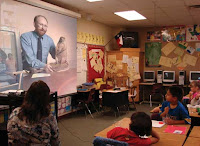
Virtual Field Trip to Carnegie Museum
This brings me to my last thought on this topic: has education really caught up to the technological world we live in?  The educational system is still evolving, and in some ways it is still very far behind.  The Future of Learning, Networked Society-Ericsson explores this topic beautifully.  The traditional role of the teacher used to be one of complete knowledge, the person with the answer to all questions.  But now, the answers are all around us.  With a simple Google search, students can find the answers to what they are looking for.  The teacher's role needs  to evolve to match this new environment. We need to teach young minds how to ask the correct question and to search for the correct answer.  Learning also needs to be differentiated.  Why should learners still be receiving the same education, taught the same way, and at the same time?  Our classrooms are diverse, with gifted students, heritage students, and students with learning disabilities.  Our teaching should reflect that, and technology can help us achieve a classroom that meets the needs of  all our students.   It's time for an evaluation  of our classrooms and what we are really preparing our students for.  That sentence opens a Pandora's Box of discussions to be had, but that's a topic for another day.  For now, I need to catch myself up to the 21st century, embrace the technological classroom, and get creative with my future lesson plans.  Because I am signing up to be a teacher of today's students and our future leaders, and I'll be darned if I don't prepare them for their future because I am, as Costa Rican's say, "behind the tree" on technology.


Until next time!

The Future Señora
Pura Vida